AI Won't Replace Product Designers. But It Will Raise the Bar
AI Won't Replace Product Designers. But It Will Raise the Bar
AI Won't Replace Product Designers. But It Will Raise the Bar
Everyone's asking the wrong question: "Will AI replace designers?" misses the point entirely.
The real question is: What does a designer actually do, and Which parts of that can AI genuinely own? Spoiler: less than you think.
AI capabilities
Let's be honest about what AI is good at
It can generate 20 UI variations before you open Figma. It can analyze usability patterns across thousands of apps, synthesize 500 user interviews in minutes, and output a component library before lunch.
That's real. That's useful. That's not going away.
But here's where it stops.
What AI can't do
AI has no skin in the game
It has never felt the frustration of an app crashing during checkout. Never had that "aha moment" when a product just clicked. It doesn't know what it feels like to be confused, delighted, lost, or relieved inside a user flow.
UX is fundamentally about human feeling, not pattern recognition, not statistical averages of what "most users" do.
A heatmap tells you where people click. It doesn't tell you why they hesitated before clicking.
That gap between data and meaning? That's where designers live.
Data is not a decision
AI can surface options. It cannot evaluate which option is right, given the business constraints, engineering tradeoffs, stakeholder dynamics, and ethical weight in the room.
Sometimes the right call is to ignore the data entirely because you understand something about the user that no dataset can capture.
That judgment is earned through experience, context, and intuition. AI has none of those.
The best design breaks convention. AI is afraid to
iPhone. Notion. Linear. Figma itself.
Every one of them went against the dominant UX patterns of their time. They were considered weird, risky, or wrong by conventional logic.
AI is a pattern-completion machine. It optimizes toward what has worked before. By nature, it is conservative.
The designer who looks at industry convention and decides to break it, that's creative courage. That's taste. That can't be automated.
Someone has to be accountable
When a dark pattern manipulates a vulnerable user into a bad decision, who is responsible?
When an AI-generated flow buries the cancel button in a way that's technically legal but clearly predatory, who made that call?
When an accessibility issue slips through because the model was never trained to think about low-vision users in that specific context, who owns that failure?
AI cannot be accountable. Designers can.
As products become more powerful and more embedded in people's lives, the need for a human with a moral compass and a name attached to the work only grows.
UX is shaping AI. Not the other way around
Here's what most people miss
AI is a product. A complex, powerful one but still a product that people have to use.
Every AI interface you interact with: the chat input, the response format, how errors are handled, the tone of the writing, that's a UX problem. Someone designed it. Someone is iterating on it. Someone is testing whether users understand what the model can and can't do.
The field of AI UX is brand new and massively underdeveloped.
Designers who lean into it now aren't competing with AI. They're the ones who will define how billions of people experience it.
So what actually changes?
Before: Designer = the person who makes the thing.
After: Designer = the person who directs, judges, and takes responsibility for what AI makes.

That's not a downgrade. That's a more important seat at the table.
Craft skills still matter; you need taste to evaluate AI output. Research skills still matter; you need judgment to know when the data is wrong. Communication skills still matter; you need to explain why the AI's answer isn't good enough.
The bar for designers doesn't lower. It moves.
What I believe
AI is a powerful tool. But, AI won’t replace designers, designers using AI might.
It will make mediocre designers faster. It will give great designers leverage they've never had before.
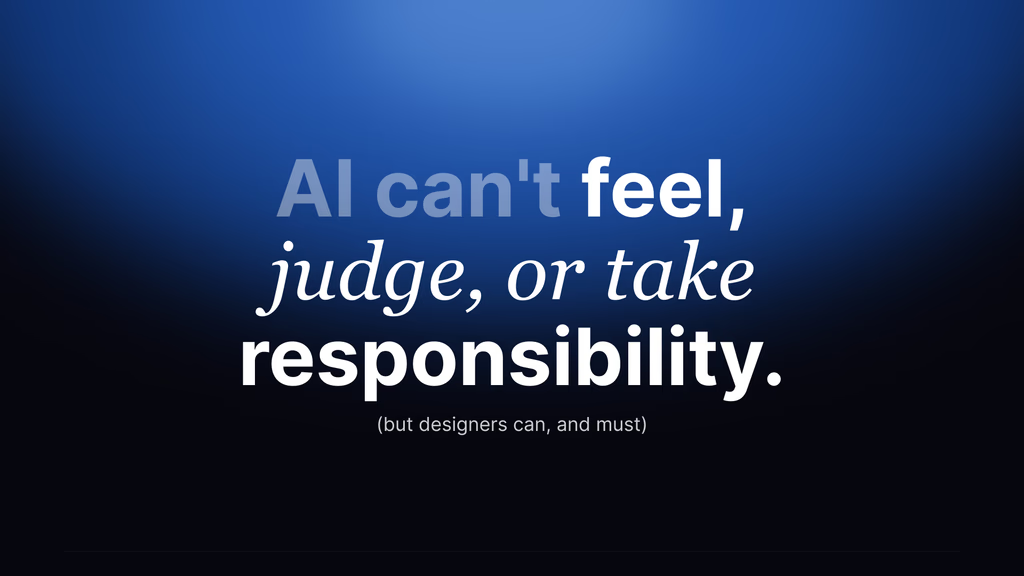
But it cannot feel. It cannot judge. It cannot be held accountable.
Those three things?
That's the job.